
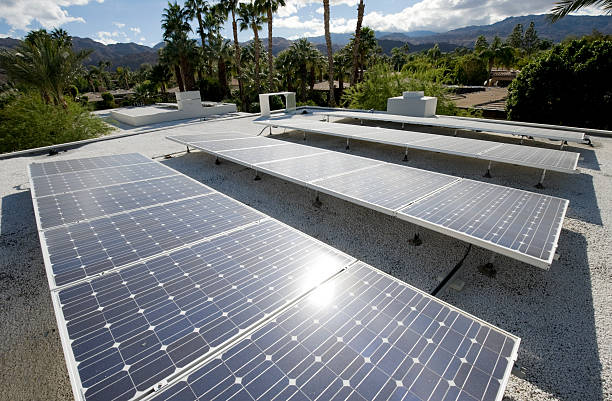
In 2016 2016, the United States reached an energy record of 1 million solar panels placed on buildings and homes. The number continues to grow, averaging 1.6 million in the year that ended.
Today, with the help of new rules approved by the California Energy Commission Wednesday, the number of homes with solar panels will likely increase in the coming years. The new set of regulations will require that the majority of new homes constructed after 2020 in California have solar panels, according to Megan Geuss from Ars Technica.
This makes California one of the states in America to establish rigorous solar-energy standards to build new structures. The new law applies to single-family homes and sure low-rise townhomes, condos, or apartments, Geuss reports. The regulations require approval from the state’s Building Standards Commission, says the Associated Press‘ Kathleen Ronayne.
“California is about to take a quantum leap in energy standards,” Bob Raymer, technical director of the California Building Industry Association, informs The O.C. Register’s Jeff Collins. “No other state in the nation mandates solar, and we are about to take that leap.”
Of the single-family detached homes in the state, just 9 percent are equipped with solar panels, Reuters states. According to Raymer, the state’s solar panel industry, only 15-20% of the new single-family homes are equipped with solar panels.
This is a positive development for renewable energy; however, there are a few issues. As Ronayne writes, some are concerned about the effects of solar panels’ added cost on the already costly housing market.
The previous year, it was reported that the California Association of Realtors predicted that median home prices would rise to $561,020 in 2018. Jeff Collins wrote for the Register at the time. In comparison, the median cost for a house for sale in the U.S. in 2018 was $357,000. Introducing solar arrays in California will likely increase the price of a new home by around $10,000.
However, they say that the California Energy Commission argues that the energy savings could reduce this cost and save homeowners about $19,000 over the next 30 years. The initiative is likely to show the overall benefit of a state-wide plan. Geuss says that the new rules will have a price tag of $2.17 billion but would result in savings in energy in the amount of $3.87 billion.
According to Reuters reports, the plan is expected to lower household emissions in the state. However, James Temple writes for MIT Technology Review that the reduction in emissions will only make up just a tiny portion of the total emissions. “[T]his feel-good change to the building code is a questionable public policy for cutting greenhouse-gas emissions.” According to him, a different policy could help reduce emissions: reducing the number and size of cars on the road by increasing the density of residential homes.
California is a leader in energy-efficient regulations and green energy plans. California is currently at the highest in the solar market, Ronayne reports. According to BBC News, more than sixteen percent of the state’s electricity was generated by solar power last year.
In general, many areas within the U.S. have strong potential for solar power. According to a Google study on sixty million U.S. buildings, 79 percent are solar-capable, meaning they have sufficient sunshine-rich areas to generate electricity, Engadget revealed in 2000. Although California is the first state to adopt the requirement, a few cities have adopted similar rules. The South Miami city South Miami became the first outside of California to follow the law, according to the Miami Herald published at the time.
Ethan Elkind, director of the climate program at the Berkeley University School of Law, tells Reuters that the new standards will likely reduce the cost of solar further since it is a large client base.
“This is pretty landmark,” the engineer says. “It helps basically provide a market for solar.”
According to the commission, around 165,000 houses and multi-family units will be constructed in the state by 2020.