
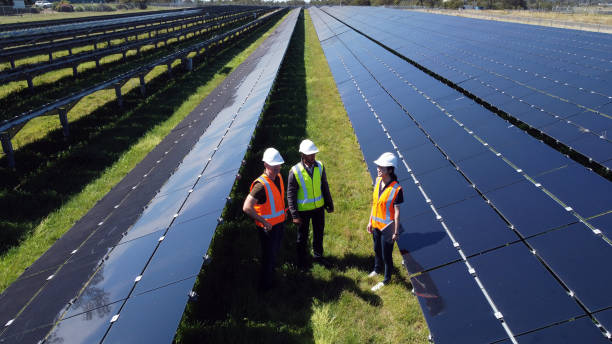
Community Solar is changing the way people view renewable energy. Forty-three states have had at least one community-solar facility since the United States passed its first community solar legislation. Its popularity grows, and more people and businesses can use renewable energy to save money. Education is an integral part of community engagement.
Anyone who has an electric bill can enjoy community solar. It is affordable, accessible, and exciting. We have spoken with thousands of people from all walks of life, and all share the same question: How does community solar work?
The Physical Structure
Before we get into the finer details of community solar, let us first define a community-owned solar farm.
Solar farms are large, aggregative projects in which multiple homes or businesses have shares in a larger solar farm. The country is home to farms as small and as large as 350kW. One megawatt can power approximately 160 homes. A typical 5MW site could power over 800 homes and businesses.
These solar projects are built in areas that have a high solar resource. They produce between 1200 kWh and 93-95% of the area’s total solar resources. Community solar is 10-15% more efficient than roof-mounted systems and can provide more value than other on-site systems.
A solar farm is a solar farm built in a specific location. The solar power generated by the farm is then gathered on a “host meter,” which helps the developer and the utility to keep track of its production. The meter is connected to the grid just like any other power plant. You get credit for any percentage of the farm that you own and a share in this total power production.
Modern Digital Energy: Remote Metering
We can hear your thoughts …” So, an off-site solar power station. This makes sense. But how do they ensure I get the power my panels generate on the farm? “.
Before we get into the details, let’s ask one thing: Forget about electrons.
It is only possible to be sure that every electron in your home comes from your solar farm if you run a dedicated wire. It is physically impossible. It doesn’t matter.
Remote Net Metering is the only concept that makes it possible to derive value from a solar farm.
Remote net Metering is an agreement between the state’s public utility commission and customers who produce their electricity from other energy sources, such as solar. Customers can transfer power they don’t use back into our grid in return for credits on their utility bills.
The energy credits earned are directly proportional to the energy produced by each farm. Each state uses a different system to calculate these credits. New York’s method is the Value of Distributed Energy Resources (VDER) Value Stack. These value calculators consider the cost of electricity, demand-reduction value, and environmental impact in determining a project’s rate.
Both residential and commercial customers can benefit from community solar. You can offset your electric bill by using this “digital energy” and eliminate your electricity expenses. This type of Metering allows you to be flexible and use solar in less-than-ideal places (think rentals or shady areas) or transfer credits to your new house.
Your Monthly Expenses
Community Solar can be a cost-effective and flexible way to eliminate electricity bills. Remote-net Metering may be a different way to deploy solar power. Still, customers who cannot go solar on their property can reap the financial benefits of owning a portion of a solar farm.
Clients have three options to access community solar: buy panels, sign long-term power purchase agreements or subscribe to a farm through shorter subscription-style contracts. Companies and developers often specialize in one type of solar access. Renovus Solar, a New York State company, offers customers all three options at one location. This gives customers the best deal.