
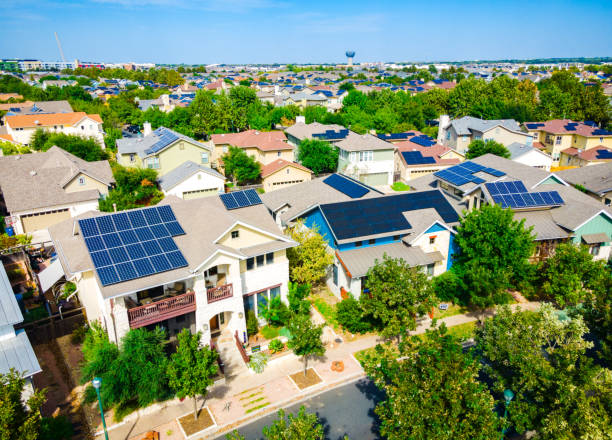
California’s solar capacity dwarfs Texas, but it is increasing quickly in both. They are number one and number two states for solar growth. California’s recent policy changes will continue these trends.
In May 2018, the California Energy Commission unanimously approved a new measure requiring solar installation in all new homes. This move aligns with the state’s goal of a 100% fossil-fuel-free electrical grid by 2045. The recent changes in the building code that will take effect in 2020 require builders to either build individual panels for each new home or connect them to a communal solar installation.
Experts say that while these requirements will increase the price of a new California home, their energy savings will make it worth the extra cost. The required residential solar panels are expected to increase monthly mortgage payments by an average of $40 but should reduce the average electricity bill by around $80.
California’s new solar regulations are a turning point for the industry: If it is successful, other states that support solar will adopt similar codes. Many state officials are now considering how similar changes to their building code would impact housing prices and solar capacity. Freedom Solar was curious to see how such a measure would affect the state of Texas. So we did some research. What we found is below.
NEW CONSTRUCTION IN TEXAS CAN HAVE A MASSIVE IMPACT ON OUR ENERGY MAKEUP
Texas’ solar industry, as well as the environment, would benefit most from a similar requirement. According to a study compiled by Environment Texas Research & Policy Center, if Texas mandated solar panels for all new homes, our state would increase 24 gigawatts of solar capacity to the electrical grids – while significantly reducing CO2 emissions.
In 2017, the Lone Star State built more new homes than any other state. Over 130,000 permits for new home construction in Dallas, Houston and Austin. Our state is expected to add 3.2 million new houses by 2045. Adding solar panels to those homes will significantly impact fossil fuel consumption.
TEXAS CITIES ALREADY REQUIRE SOLAR BUILDINGS
It wouldn’t be surprising if such a measure were approved in Texas. In Texas, there is a precedent of solar-related requirements for building. Texas’s major metropolitan areas have already rewritten their building codes to encourage the installation of solar panels on newly built homes.
Austin, Houston and Lewisville, a Dallas suburb, have all approved solar requirements for new homes. Austin’s building codes require that new buildings are “solar ready,” meaning their roofs must be designed with sufficient surface area for solar panels. This requirement also applies to commercial and multi-family buildings, making it one of Texas’s most comprehensive solar-related requirements.
Houston was the first Texas city to adopt a “solar-ready” mandate. These provisions require that new home builders construct roof surfaces to accommodate panels and reserve electrical service space for solar installation. When applying for building permits, builders must submit a sample site plan for the Solar Ready Zone.
SOLAR REQUIREMENTS – THE BIG IMPLICATIONS
It is common for other areas to take action when one region adopts more progressive solar policies. Texas’s cities that are solar-ready are an excellent example. In a presentation before the Austin Electric Utility Commission and Resource Management Commission, the RMC vice-chair argued that Houston’s requirements for solar-ready buildings set a precedent for similar building codes in Austin.
Some opponents of the new measures claim that solar panels and solar-ready homes would increase the price of new homes. According to environmental experts, solar regulations such as these could reduce the cost of solar systems by as much as 59%. While new home prices may initially rise after implementing these requirements, solar will eventually become more affordable to everyone. Of course, this does not include the potential savings in energy and home resale values that could offset any additional housing costs.
It needs to be clarified if such a revision of the statewide construction code will ever be approved in Texas. Still, utility commissioners, solar panels installers and other energy industry professionals are now all looking to California to see what the new regulations look like.
But you can start saving money on your electricity bill before Texas approves new solar measures. Install solar panels in your home today. Call us today and speak with a solar energy specialist.