
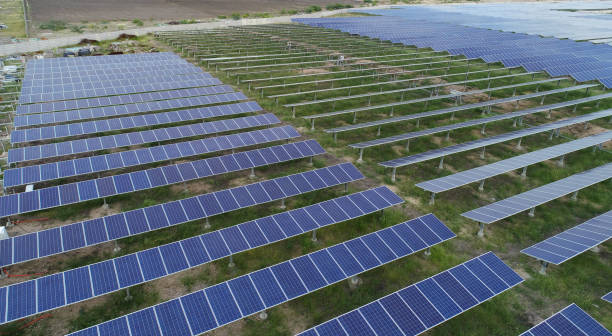
The floating solar panels placed on the surface of reservoirs throughout the world could provide enough energy to power cities in the thousands, according to a research study released last month in Nature Sustainability.
They are called floating photovoltaic systems, called “photovoltaics,” these solar arrays work the same as the panels on land by capturing sunlight and generating electricity. They are positioned on floating platforms and remain in place thanks to cables connected to the water body’s base, according to The Wired‘s Matt Simon. New research has shown that this technology is buoyant and can generate vast amounts of power and save water without taking up space on the land.
The researchers considered the amount of electricity that could be generated if 114,555 reservoirs across the globe had 30 percent of their surface covered by floating photovoltaics that were capped at the equivalent of 30 sq km for each pool. They estimate that globally the panels could generate more than 9,000 terawatts of energy each year, or around 2.4 more than what the United States consumed in 2021.
“That’s remarkable,” J. Elliot Campbell, a co-author of the latest study with an environmental engineer from the University of California, Santa Cruz, informs Wired. “It’s around ten times the current production from solar. The solar industry is growing rapidly. If there ever was an opportunity to think about what to do with all of this and how to manage it, it’s now.”
A few countries have already addressed this question by using floating solar panels for limited quantities, such as Brazil, China, India, Indonesia, Singapore, South Korea, Thailand, and Vietnam. California intends to experiment with an identical idea where solar panels are set over the irrigation channels.
If local photovoltaics were to be adopted further and 6,256 cities spread across the 124 nations could fully satisfy their energy needs, researchers discovered. This will primarily benefit small towns: About 70% of cities in these areas have populations of less than 50,000. However, more urban cities may need more space on reservoirs to provide for their people, as the authors point out.
The five countries which could produce the most electricity by expanding or introducing their use of solar cells that are floating are U.S., China, Brazil, India, and Canada. The U.S. could produce almost 50% of its electricity needs in 2021 through floating solar if it adheres to the study’s restrictions – 30 % of the reservoirs that are at most 30 square kilometers for each one.
Beyond power generation, floating solar panels can save an estimated approximately 106 cubic kilometers of water per year, similar to the amount utilized annually by the 300 million people there. This is because the panels provide shade and lower the water temperature, leading to lower evaporation rates, according to Ars Technica‘s HTML2John Timmer. In the face of arid conditions in various regions of the globe, This could bring some relief.
The water cools the solar panels, thereby making floating photovoltaics up to fifteen percent better, as solar panels located on the land produce less power and require more maintenance in the event of overheating.
Solar panels installed on the land are a safe renewable power source; they also take up lots of space. They take up land that could be used for agricultural or habitat conservation, as per The Verge‘s Justine Calma.Justine Calma.
“Land usage is now a major issue in renewable energy. There is a lot of concern about competing land uses, and in some areas it may be difficult to locate land,” Lara Hayim, head of research on solar at BloombergNEF, who did not participate in the study, told Bloomberg’s Carly Wanna. “So in those places, there is a bit of an incentive to build on water.”